
Common SEO Mistakes That Stop Websites from Ranking
Ranking your website in the top page of Google doesn’t simply involve creating content. There are many websites that do not rank due to simple SEO mistakes that they never know. Even if your site looks good and you offer valuable content, some common mistakes could be enough to block your site from appearing on Google.
Many beginners usually ask what is SEO in digital marketing as they think SEO is simply about using keywords. But SEO is more than that. Knowing what is SEO in digital marketing will help you avoid making common mistakes while building your site.
Here, we will take a look at the most common SEO mistakes that can prevent websites from ranking in Google and how you can overcome them.
1. Ignoring Search Intent
The most common SEO blunder people make is creating content without knowing what the user wants to know. Google values content that answers the users’ questions thoroughly.
For instance, when a user is searching for “the best SEO tools,” they are not interested in the evolution of the search engines but need some tips and recommendations to use the right SEO tool.
Before you even start creating a blog post, ask yourself:
What question does the user have?
Do I give the user an answer to this question?
Is my information helpful?
2. Publishing Low-Quality Content
Google has an affinity for sites that offer constructive, useful, and informative content. Manifold websites either copy texts from other websites or publish poor blogs due to which a reader is deprived of any critical information.
This approach must be thoroughly changed towards providing truly useful information to the visitors. That is to say that if any person asks for the definition of “What is SEO in digital marketing,” it is necessary to respond with the whole definition elaborating on it in more detail along with examples.
Thus, by posting useful content, a website obtains better engagement levels and improves its rankings.
3. Keyword Stuffing
Most beginners believe that repeating the same keyword many times in an article improves ranking positions. This method does not work anymore.
Google understands natural language and user intent. Use the focus keyword naturally in your article. Always write articles for people rather than only for search engines.
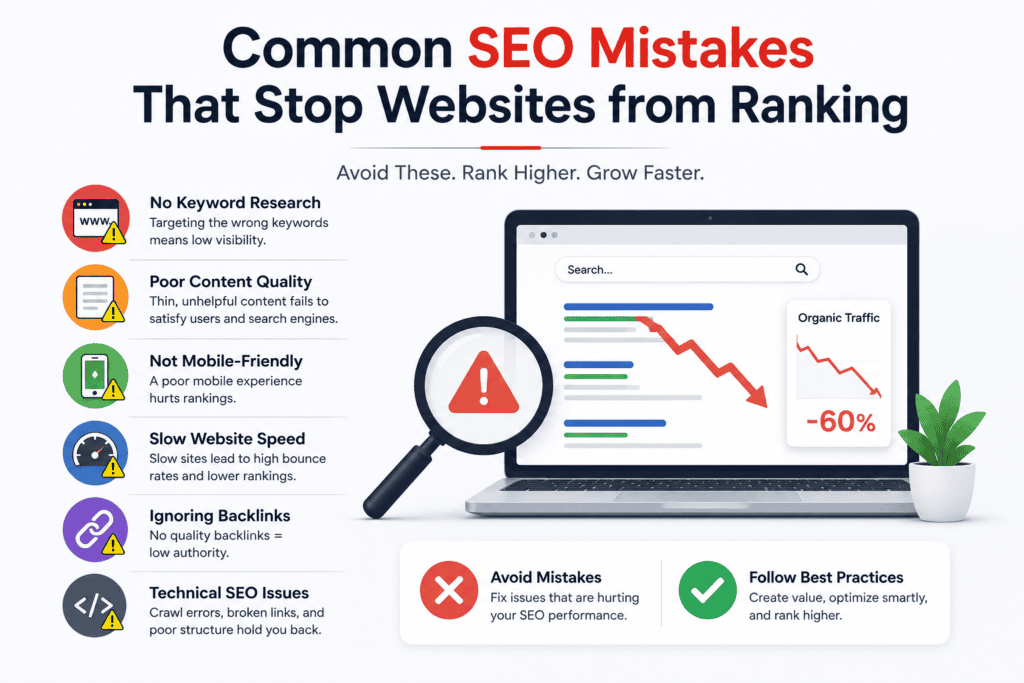
4. Slow Website Speed
Site speed is one of the ranking criteria. If it takes a lot of time to load your site’s pages, users will most likely turn away from your website.
To increase the speed of your site:
Compress the big images.
Use good web hosting services.
Don’t install extra plugins.
Browser caching should be enabled.
Minify CSS and JS files.
Faster site equals happy users and search engines.
5. Poor Mobile Experience
The present-day people access the internet through their mobile phones. If your website is lacking in mobile usability, then you may face some penalties from Google.
Your website must:
Load fast on mobile phones.
Contain readable fonts.
Be responsive in nature.
Have clickable buttons.
Offer relevant content irrespective of the screen size.
6. Missing Meta Titles and Descriptions
Your meta title and meta description will help search engines understand what your page is all about. It will also encourage users to come to your site.
There should be:
Unique meta title.
Meta description.
Keywords.
Do not repeat your title and description on other pages.
7. Weak Internal Linking
These links allow the user to find additional information on your website. Additionally, they assist Google in recognizing the connection between different pages.
If necessary, add links from your blogs to:
Articles that are related.
Services.
Categories.
Important landing pages.
8. Poor Quality Backlinks
Backlinks continue to be one of the most powerful ranking factors for Google. But not all backlinks are useful.
Bad and spammy websites’ backlinks can hurt your SEO efforts. So you should forget about backlink buying and start working on getting natural backlinks through high-quality content creation.
9. Not Updating Old Content
SEO is not a one-off process. Google favors fresh and updated content.
Update your old blogs with:
New stats.
Updated screenshots.
Deletion of outdated content.
Improved readability.
Additional information.
Updating old blogs is better than writing a whole new blog post from scratch.
10. Forgetting User Experience
No matter how good the content, poor user experience will affect you.
Your website needs to be:
Easy to navigate.
Fast-loading.
Neat and organized.
No need for irrelevant pop-ups.
Mobile-friendly.
Google loves sites with an amazing user experience.
How to Avoid These SEO Mistakes
SEO optimization of your site does not necessarily have to be hard.
Some tips include:
Write unique and valuable content.
Know the intent of the user prior to creating content.
Keyword usage.
Website optimization.
Mobile friendliness.
High quality backlinks.
Internal links.
Regular content updates.
Human first; then the search engine.
These easy to follow tips will make your site successful.
Final Thoughts
When you become aware of the basic knowledge about SEO for digital marketing, you will realize that SEO consists of good content, technical optimization, and a great user experience. Whatever you do helps the search engines understand your website more, as well as providing relevant information for your users.
Just make sure that you stay away from the SEO errors talked about above and keep on optimizing your website.