
Performance Marketing vs Brand Building: Where to Spend Your First Marketing Dollars
Introduction
Starting a company is really tough. You have to think about how you use your time and money. Every dollar counts. When you spend money you need to know it is being used in the way. If you make a mistake with your marketing budget it can be bad for your company. You might even have to close down.
When you plan how to grow your company you will have to make a decision. Some people will tell you to spend all your money on performance marketing. This means things, like Facebook ads and Google ads. They say you will get results away and be able to track how well your ads are doing. On the hand some people will say you need to focus on building your brand. This means creating a look and feel for your company telling a story and making your products look really good. They think that if you do not have a brand that people care about your company is not special.
You have to think about performance marketing and brand building. Performance marketing is when you pay for ads and can see how well they are doing. Brand building is when you try to make your company mean something to people. Performance marketing can give you results away.. Brand building is important too. It is how you make your company stand out. You have to decide where to spend your money. Do you spend it on performance marketing or brand building?
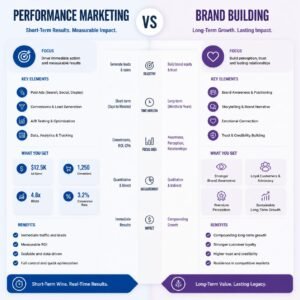
It feels like a classic, high-stakes tug-of-war: immediate sales versus long-term loyalty. If you spend everything on direct sales, do you sacrifice your future? If you spend everything on your image, do you go bankrupt before next month?
So, where should you actually spend your first marketing dollars? Let’s strip away the corporate buzzwords, ignore the agency pitches, and look at the raw reality of how to balance these two pillars without going broke.
Defining the Contenders: What Are We Actually Comparing?
To make the right strategic choice for your business, you have to look past the surface and understand what these two marketing methodologies actually do for your business structure.
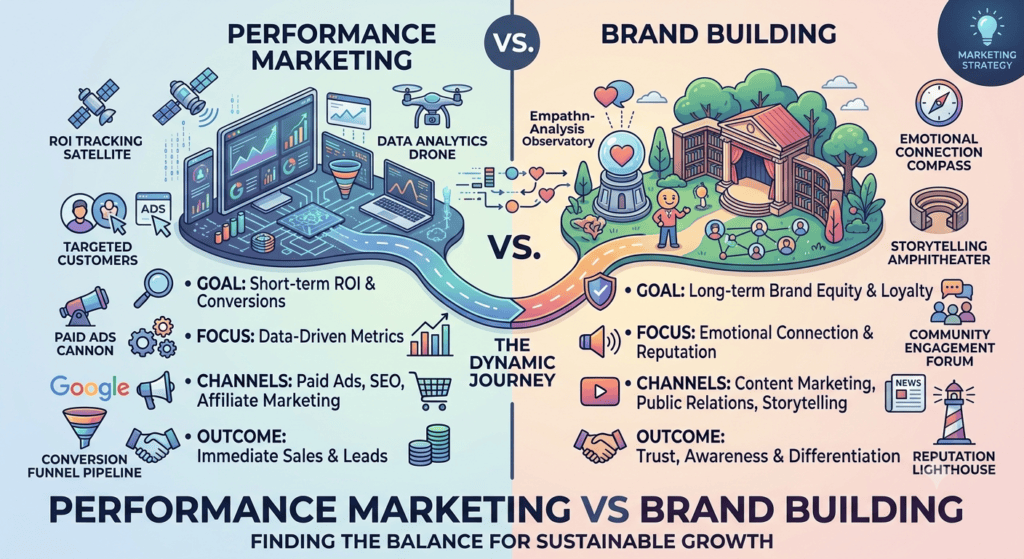
What is Performance Marketing?
Performance Marketing is like a deal. You pay money to a platform you show an ad to a person and you see what happens. Like if they click on something or buy something right away. It is about getting a quick result. You put ten dollars into an ad. After one day you can see if you got fifteen dollars back.
Performance Marketing is meant to make someone stop what they are doing look at a product and buy it now. It does not care if someone remembers your company name later. What it cares about is if someone buys something from you today.
What is Brand Building?
Brand Building is different. It is about how people feel about your company. It is about what your company looks like what you say about quality how you talk to people on media and how you treat your customers. Brand Building is also about the community you create around your products. It does not ask people to buy something away. Instead it tries to make people trust and like your company over time. Brand Building is like building a relationship, with people it takes time to work.
The ultimate goal of a brand is to ensure that when a customer is finally ready to buy a specific type of product, they bypass the search engine entirely and choose your storefront automatically over a sea of generic, unnamed competitors. Brand building is what turns an impulse buyer into a lifelong advocate.
The Ultimate Dilemma: The Trap of Choosing Just One
Many startups make the fatal mistake of choosing one side of this coin and completely ignoring the other. In the early stages of a business, committing strictly to one extreme creates severe vulnerabilities that can completely halt your growth engine.
The Performance-Only Trap: The Growth Ceiling
If you only run direct-response performance ads, you will likely see a nice, exciting spike in sales early on. But you are essentially building your entire corporate infrastructure on rented land. You are completely dependent on the algorithms of Meta, Google, or TikTok. The moment you turn off your ad budget or reduce your daily spend, your sales drop to absolute zero.
Even worse, as ad platforms get more crowded and data privacy laws tighten globally, your customer acquisition costs will steadily rise. If your product looks exactly like everyone else’s and has no distinct identity or emotional equity behind it, you will eventually hit a brutal growth ceiling. You will reach a point where your ads cost more than the profit your products generate. You become a commodity, trapped in a permanent, exhausting race to the bottom on pricing and discount codes.
The Brand-Only Trap: The Beautiful Bankruptcy
Conversely, if you spend your entire initial seed budget on beautiful packaging, premium custom boxes, a luxury logo design, and high-production brand video shoots without any active distribution strategy, you will run out of money before the market even discovers you exist.
A nice brand identity is not worth much if people are not looking at it. New startups do not have the freedom as huge companies to spend a lot of time and money on fancy campaigns that do not bring in any sales. You cannot pay the people you buy things from the companies that help you deliver your products or the people who host your website with likes on media or because your brand looks nice. You need money to pay these people.
The Verdict: Where to Spend First
So what should a new startup do first if it wants to grow wisely?
The answer is easy: Performance marketing helps you pay your bills today but building your brand identity helps you pay your bills tomorrow. Building your brand identity is important for the future and performance marketing is important, for now.
Therefore, your initial phase must lead with performance marketing—but with a heavy, non-negotiable structural twist. You should use direct-response channels to drive immediate cash flow, but you must design and execute those campaigns using the distinct visual language, integrity, and voice of a long-term brand. You do not choose between them; you execute them simultaneously within the exact same ad creative.
Here is a step by step plan to help your startup spend money focus on things and use energy in the way as it grows from a new store into a big company.
The Startup Scaling Plan
Internal links enable visitors to navigate your website and help search engines find significant pages on your website.
Pros:
Crawlability improvement
Page authority increase
Increased time on site
Content discovery improvement
Insert internal links to related pages into your content naturally.
Phase 1: Just Getting By (0 to 1,000 Sales)
The Money Plan: 80% goes to ads that work well and 20% goes to building the brand
The Goal: Make sure people like your product and get money coming in right away
When you first start out your main goal is to make sure people want to buy what you are selling and get some money coming in quickly. You need to know what people think of your products. You need to know fast. You cannot just guess if people, like the things you are selling you need to see if they are actually buying them. Put most of your money into ads that will bring people to your website away or use social media to get people to buy from you. The startup needs to use its money to get people to look at the startups products and buy them this is what the startup needs to do to get money coming in.
However, use that remaining 20% incredibly wisely. Instead of hiring an expensive branding agency or buying luxury promotional assets, invest your brand budget into micro-foundations that immediately elevate the actual customer experience. This means ensuring your product packaging feels premium upon arrival, your unboxing experience is highly shareable on social feeds, and your organic social media accounts look clean, professional, and intentional. Every single performance ad you run should look like it belongs to a real, cohesive brand—not a generic, sketchy dropshipping store.
Phase 2: The Stabilization Shift (1,000 to 10,000 Sales)
The Budget Allocation: 60% Performance Marketing / 40% Brand Building
The Primary Focus: Customer Retention, Lifetime Value, and Community
Once you have consistent, predictable daily sales coming through your pipeline, your customer acquisition costs will naturally start to creep up if you rely purely on targeting cold audiences with raw product pitches. This is the exact moment to shift more of your capital and creative resources into building long-term brand equity.
Start investing real time into high-quality organic content marketing, building an active, automated communication community on channels like WhatsApp or Instagram, and collaborating with micro-influencers who truly embody your specific aesthetic. At this stage, your brand building serves a highly practical, mathematical purpose: it drives up your customer lifetime value and repeat purchase rate. If your brand story is compelling and your community feels exclusive, customers will return to buy from your store organically. This gives you high-margin, zero-ad-cost sales that effectively offset your paid acquisition costs on Meta or Google.
Phase 3: The Market Leader (10,000+ Sales)
The Budget Allocation: 40% Performance Marketing / 60% Brand Building
The Primary Focus: Emotional Dominance, Subculture Alignment, and Organic Demand
When your startup reaches this level of scale, true brand building takes the driver’s seat of your entire corporation. Your goal shifts from introducing people to your products to making sure your brand name becomes a definitive lifestyle choice or subculture statement. Think of how top global streetwear, apparel, or lifestyle brands operate at scale; they almost never run basic ads saying “Buy this item for twenty dollars.” They sell an identity, an elite community membership, an attitude, and a hyper-curated aesthetic.
At this level, your massive organic brand pull ensures that your performance ads become incredibly efficient. Your paid campaigns are no longer trying to convince skeptical strangers to trust you; they are simply reminding an audience that already loves, trusts, and recognizes your name to check out your latest collection.
How to Make Performance Ads Build a Real Brand
You don’t need millions of dollars in venture capital to build a premium brand identity; you just need radical, absolute consistency across every single touchpoint. You can actually turn your daily performance ads into long-term brand-building assets by following three strict creative rules:
1. Own a Signature Visual Style
Choose a specific, tightly controlled color palette, a definitive typography framework, and a consistent way of shooting your products. Whether your style is raw, organic, smartphone-shot video or a clean, bright, minimalist studio look, stick to it across every single ad creative you launch. When a user scrolls past your ad three times a week, they should instantly recognize it’s your brand before they even read your store name.
2. Talk Like a Normal Person
Stop using that corporate language and those annoying sales pitches that sound like spam. Just talk like your customers do when they text their friends or comment on media. Use the slang and casual language that they use. This is what makes a brand really authentic.
3. Focus on the Style and the Look, Not the Price
Do not keep saying “50% OFF EVERYTHING” or “CHEAP PRICES” in your ads. This actually makes your brand look cheap over time. Instead make ads that show the kind of life your product’s about what inspired the design how good the printing is or what problem it solves. Try to make people see the value, in your product than just making it cheap. This way you build a brand and that is what matters.
Summary
Stop treating performance marketing and brand building like bitter, ideological rivals. They are not competing philosophies; they are simply two halves of the exact same corporate growth engine. One cannot survive long-term without the other.
If you are just starting out in the market, spend your capital on performance marketing to buy immediate visibility, traffic, and revenue, but execute that strategy with the soul, design consistency, and visual integrity of a premium brand. By using your performance ads to fund your immediate cash flow while staying strictly loyal to a unique, unmistakable identity, you will build a highly profitable startup that doesn’t just survive algorithmic shifts, but dominates its niche for years to come.